Anonymous research poster / v89
Learning When to Reason
Same calls. Better timing. More events covered.
Question. With a fixed number of reasoning requests, which moments should receive them?
Approach. Learn pre-event opportunity scores; compare constrained call sets at exact call parity.
Predict opportunities; maintain control
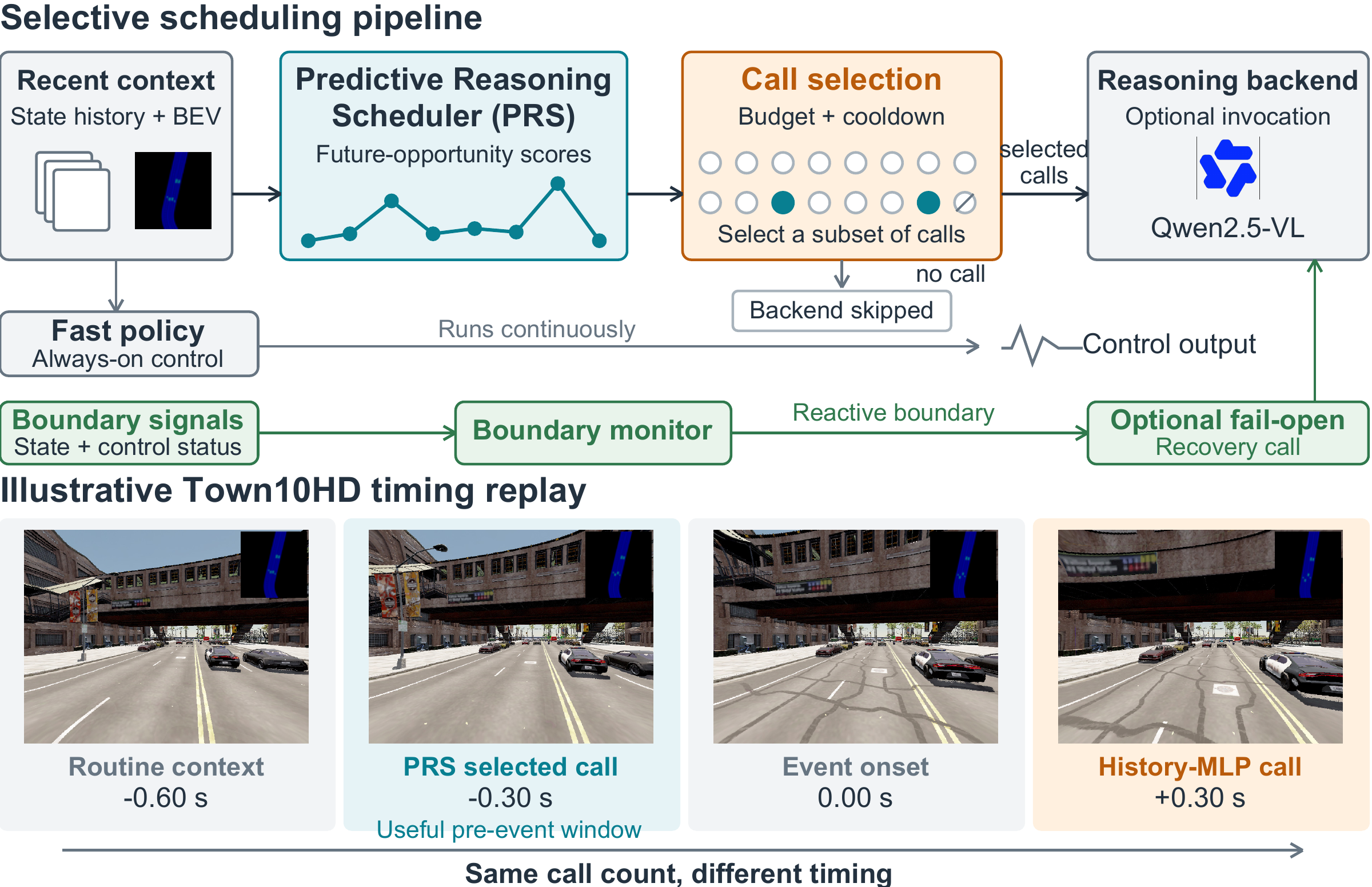
Recent state history and compact BEV context inform opportunity scores. The fast policy continues controlling the agent; reactive recovery follows an independently accounted path.
The timing images are illustrative frames from a separate visualization run.
What is measured?
Useful-Window Coverage (UWC) is the fraction of distinct event-specific pre-onset windows reached by at least one call.
Frozen trajectories and identical call counts isolate placement quality. Backend answers, online commitment, and closed-loop utility are separate questions.
165 calls: 23 event windows versus approximately six
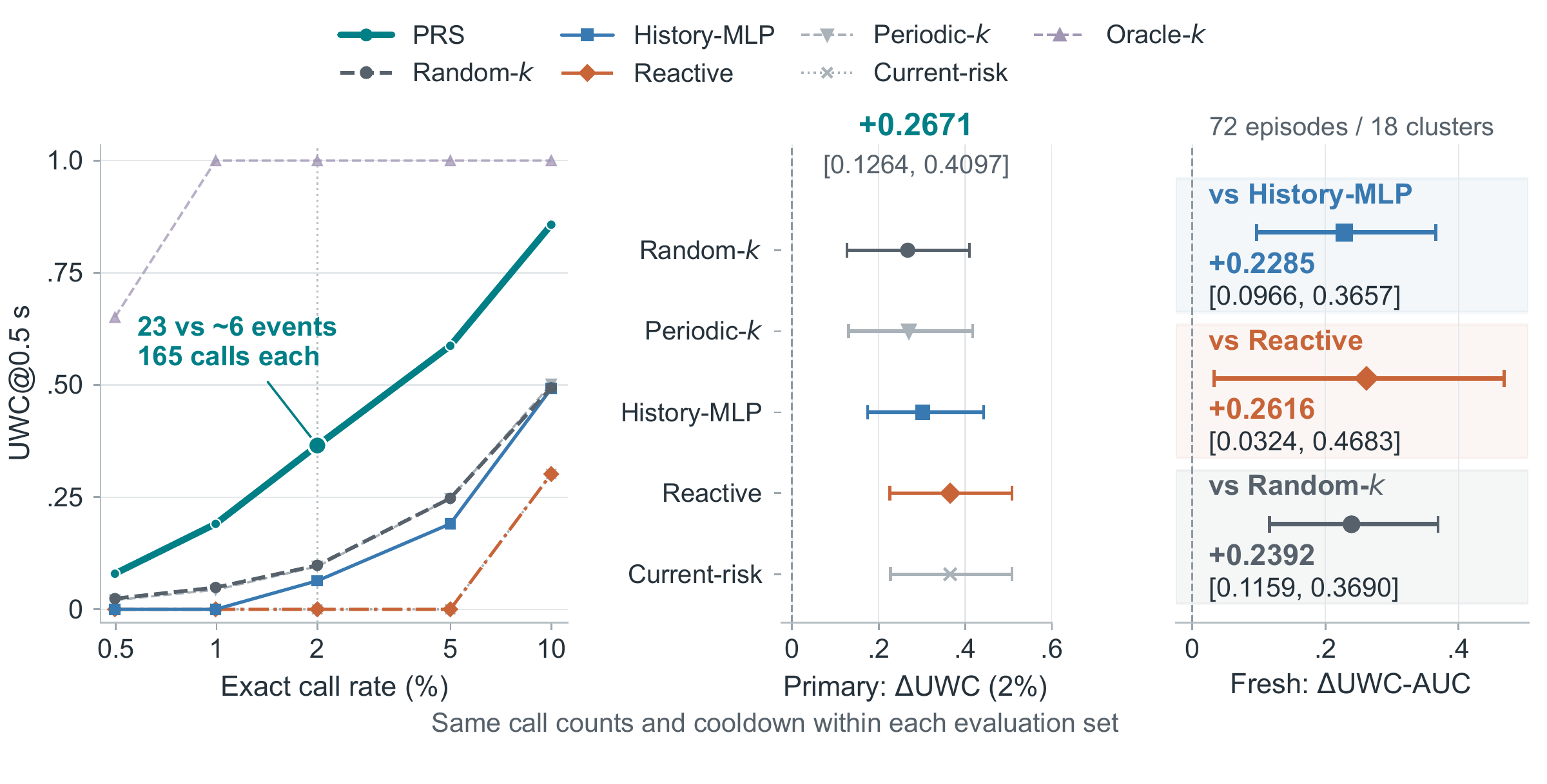
+26.71 percentage points UWC@0.5 s at the 2% budget
95% bootstrap interval: 12.64 to 40.97 percentage points. The primary Town10HD comparison uses a development-selected checkpoint; Random-k is the strongest non-oracle baseline at this budget.
On fresh Town10HD scenarios, a separately frozen development-selection procedure yields +0.2392 normalized log-budget UWC-AUC over Random-k, with positive differences at all five budgets.
Selected-model evidence does not establish arbitrary-seed stability. Complete seed distributions and matched-search comparisons are retained in the paper and data.